Camp Gear Advisor
Camp light glowing at a campsite
Back to gear hub

Lights

Lighting is easy to forget about until you are trying to find something in your tent after dark. A good light does not have to be fancy, but it should make camping easier when you need to move around, cook, or settle in at night. This page gives you a simple place to start with a few lighting and power options worth considering for camping.

As an Amazon Associate, Camp Gear Advisor may earn from qualifying purchases. Prices and availability can change, so check the product page for current details before buying.

Headlamps

Hands-free lights for setting up camp, cooking, and moving safely after sunset.
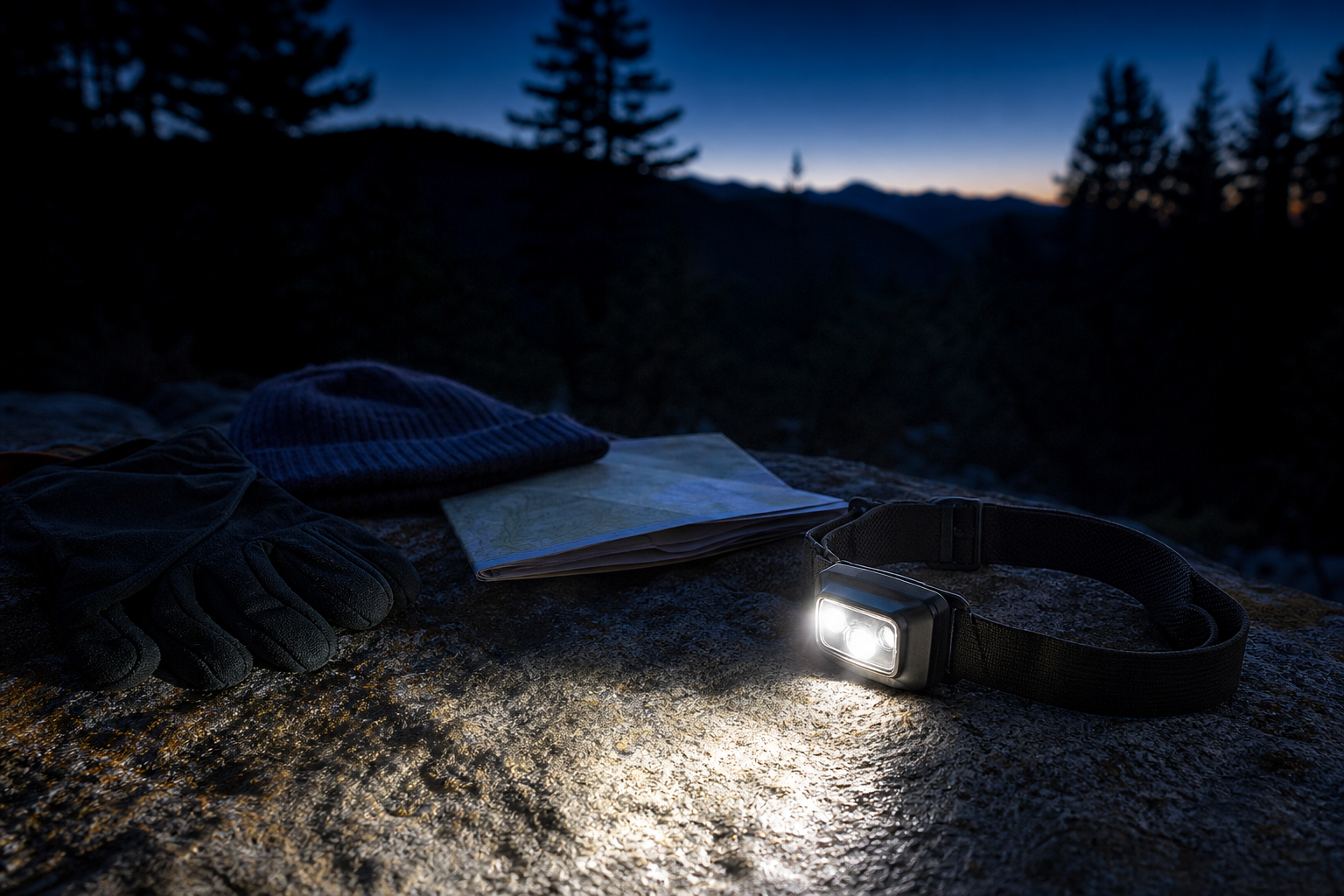
Headlamp casting a beam across trail essentials before dawn

A headlamp is usually the first light worth buying for camping because it keeps both hands free. That matters when you are setting up a tent, cooking, carrying water, looking for something in a bag, or walking around after dark.

For beginners, brightness is only part of the decision. A comfortable fit, simple buttons, decent runtime, and the right beam are just as important. A wide flood beam is useful for camp chores and close-up work, while a spot beam helps more when you need to see farther down a trail.

A red light mode can also be useful at night because it is less harsh and helps preserve your night vision. You do not need the most powerful headlamp on the shelf; you need one that is easy to use and still has battery when you reach for it.

Below are a few headlamp-style options and accessories that can make nighttime tasks easier while camping.

1Black Diamond Spot 400-R Rechargeable HeadlampThe Spot 400-R is the headlamp I would point a camper toward when they want one light to handle setup, cooking, bathroom walks, and bad weather. It has enough output for normal camp chores, a red mode for less harsh nighttime use, and a rechargeable setup so you are not burning through batteries every trip. The controls take a little practice, but it is a solid main headlamp.
Pros
  • Rechargeable design
  • Waterproof build
  • Red mode and strong campsite output
Cons
  • Controls take learning
  • Micro-USB on this listing
  • Costs more than bargain headlamps
2Black Diamond Spot 400 HeadlampThe standard Spot 400 makes sense for campers who still prefer replaceable batteries or want a backup light that does not depend on charging access. It gives you a dependable camp beam and weather confidence while letting you carry spare AAA cells. The button modes can feel busy at first, but it is a practical choice for people who like simple battery planning.
Pros
  • Replaceable batteries are easy to carry
  • Solid brightness for camp tasks
  • Good bad-weather backup
Cons
  • Uses disposable batteries unless paired with rechargeables
  • Button modes can be complex
  • Less convenient than built-in USB charging
3Nitecore NU25 MCT UL HeadlampThe NU25 is for campers and backpackers who notice every extra ounce. It is small, USB-C rechargeable, and easy to justify in a lighter kit, especially for organized weekend trips. It does not feel as rugged as heavier headlamps, so it is best for people who want low weight and are willing to treat their gear with a little care.
Pros
  • Very light
  • USB-C rechargeable
  • Multiple color-temperature modes
Cons
  • Smaller battery than heavier headlamps
  • Less waterproof than Spot models
  • Ultralight strap feel is not for everyone
Lanterns and Camp Lights

Area lighting for picnic tables, tents, and relaxed evenings around camp.

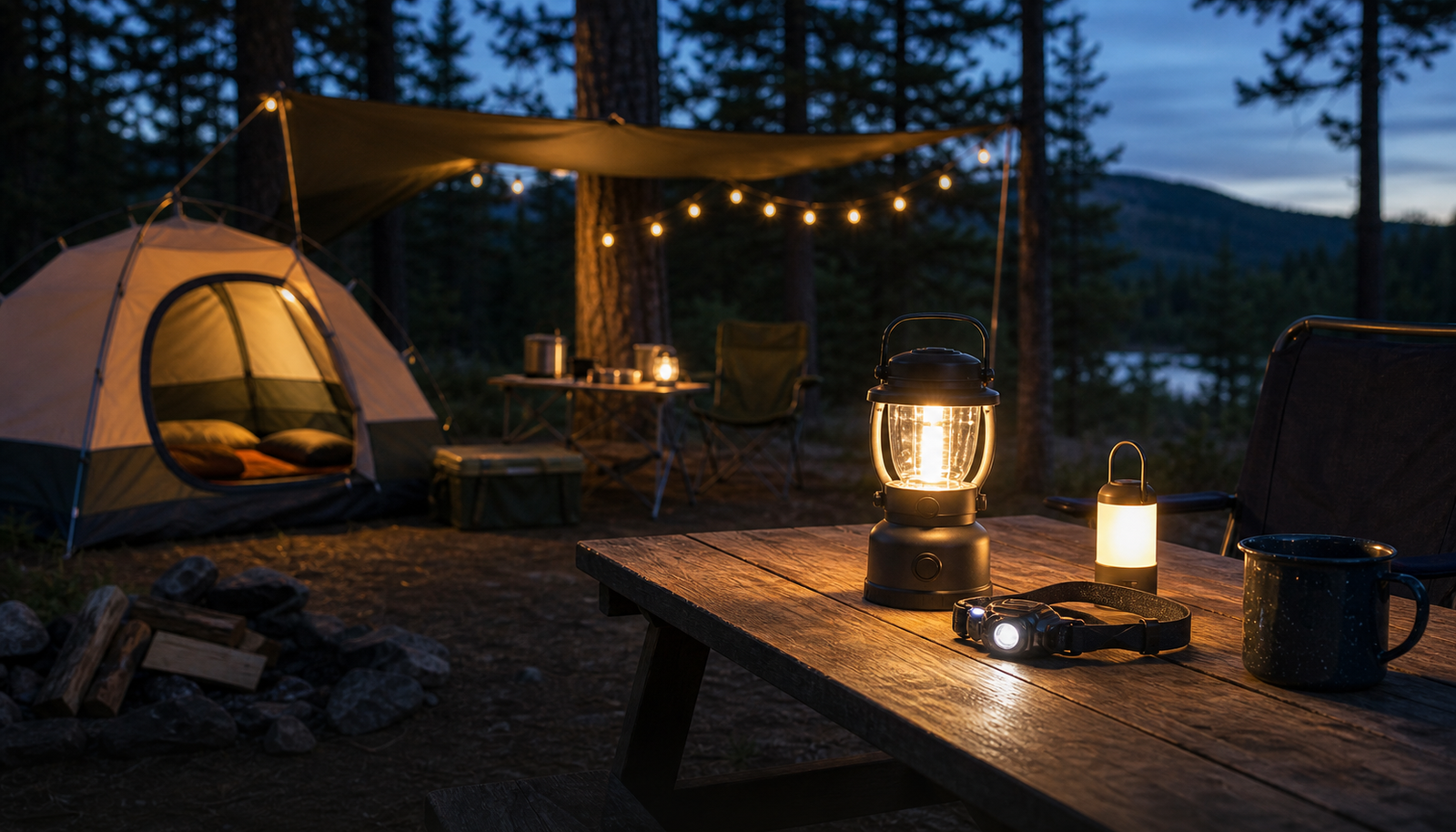
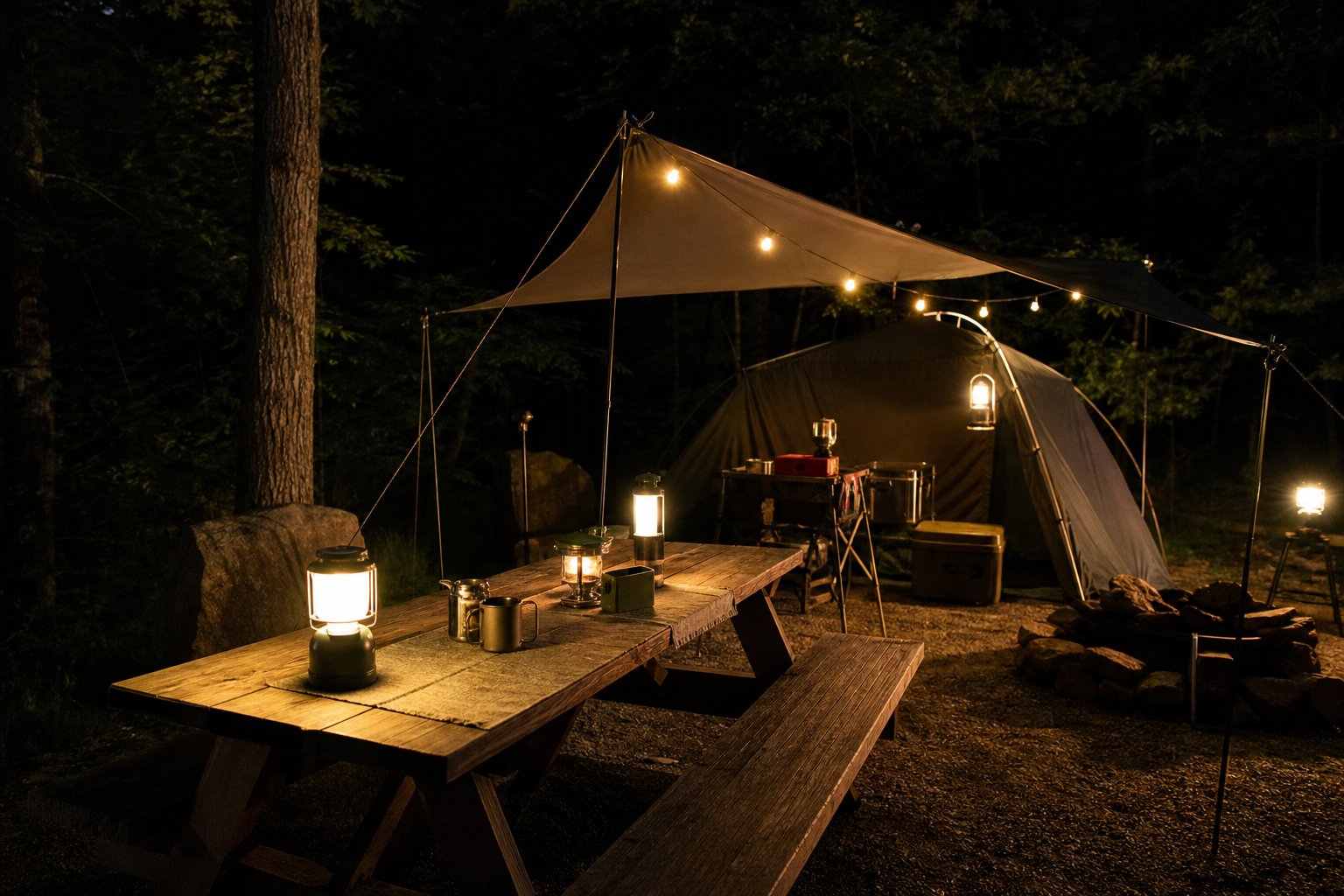
Warm lanterns and camp lights illuminating a tent and picnic table at night

Lanterns and camp lights are for shared spaces. They help around the picnic table, cooking area, tent entrance, or anywhere people are sitting together after sunset. This is different from a headlamp, which only lights wherever one person is looking.

LED lanterns are usually the easiest starting point for new campers because they are quiet, cool-running, simple to use, and safe around kids compared with fuel lanterns. Fuel lanterns can be very bright, but they also get hot, need ventilation, and take more care to use well.

The main thing is to use enough light without lighting up the whole campground. Shielding lights, pointing them down, dimming them when possible, and turning them off when you are done keeps the campsite usable without bothering nearby campers or washing out the night sky.

Below are a few lantern and camp light options that can help brighten shared areas without making the setup complicated.

1BioLite AlpenGlow 500 LanternThe AlpenGlow 500 is more about making the picnic table usable and pleasant than blasting the whole campsite with light. The warm dimmable output is the useful part; the color modes are a bonus if you like them. It costs more than a basic lantern, but for relaxed evenings, family sites, and tent-area lighting, the nicer light quality is noticeable.
Pros
  • Warm pleasant area light
  • Rechargeable
  • Dimming and color modes add flexibility
Cons
  • Pricey
  • Color modes may be more than some campers need
  • Micro-USB charging
2Fenix CL26R Pro Rechargeable LanternThe CL26R Pro is the practical utility lantern in this group. It can hang, stick magnetically, sit near a cooking area, or work as a small task light, which makes it easier to place than a basic table lantern. There are several modes to learn, but campers who want one compact light to do several jobs will get more out of it.
Pros
  • Bright for its size
  • USB-C rechargeable
  • Replaceable battery and flexible mounting
Cons
  • Interface has several modes to learn
  • More expensive than basic lanterns
  • Small size limits broad campsite coverage
3MPOWERD Luci Solar String Lights + Phone ChargerThese are not the lights you buy for serious cooking or repair work; they are for soft campsite visibility once everyone is settled in. They help define a tent, awning, or picnic-table area so people are not wearing headlamps all evening. Solar charging is useful, but I would still charge them before leaving rather than trusting the weather.
Pros
  • Creates pleasant campsite ambiance
  • Solar and USB charging options
  • Packs into its own hub
Cons
  • Not task-bright
  • Solar charging depends on sun
  • String setup takes more time than a lantern

Small Task Lights

Smaller lights for tents, gear bins, picnic tables, and quick tasks around the campsite.

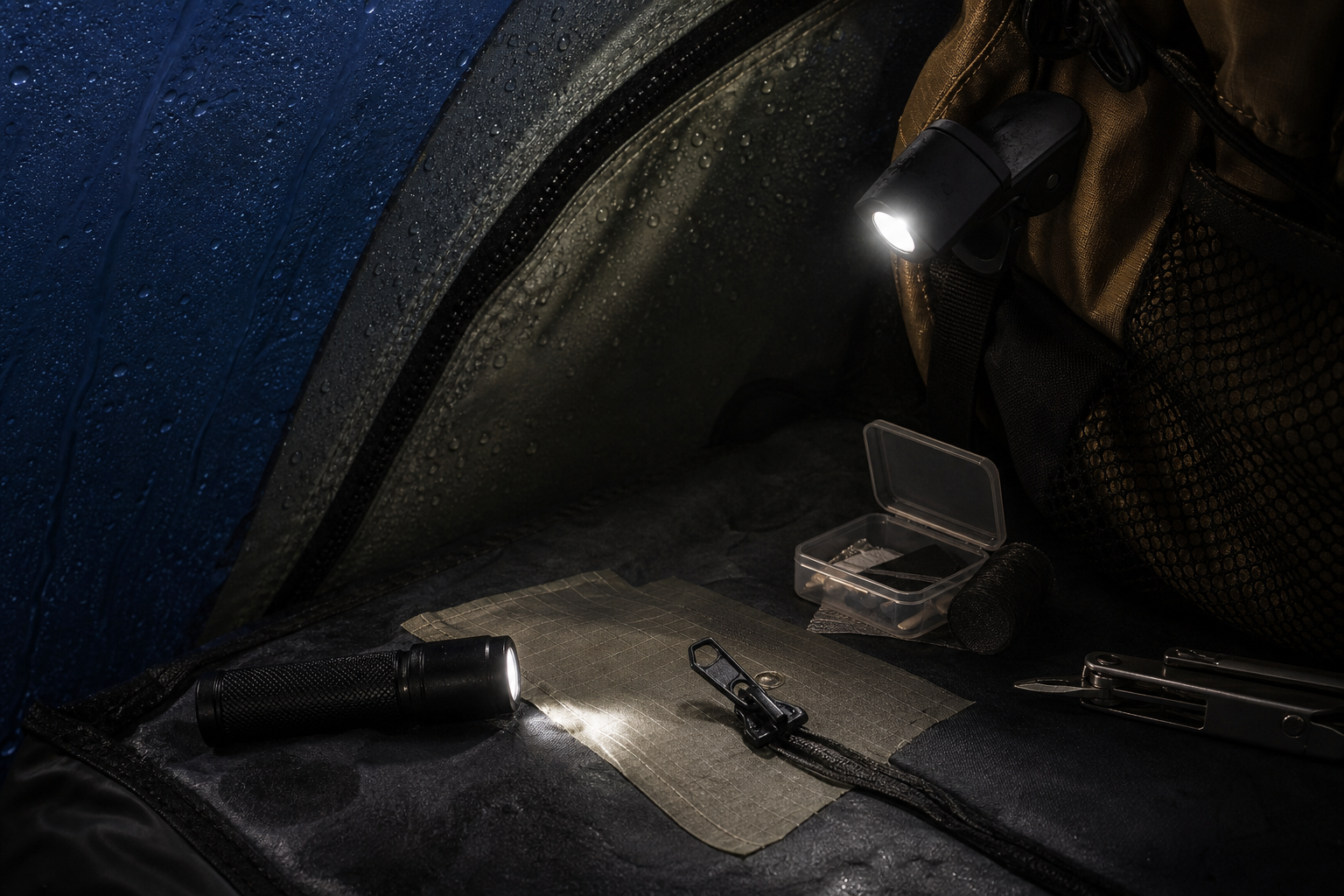
Small task light illuminating repair gear inside a rainy tent vestibule

Small task lights are for the little moments when a headlamp or full lantern feels like too much. They can help inside a tent, near a gear bin, on a picnic table, or anywhere you need a softer light close by.

This category is useful because beginners often realize after the first night that one main light does not solve every problem. A clip-on light, mini lantern, or hanging tent light can make it easier to find socks, check a zipper, read, or keep a small area visible without waking everyone up.

The best small lights are simple to place and simple to turn on. If a light is awkward to hang, hard to charge, or too bright for close use, it probably will not be the one you reach for.

Below are a few small task lighting options that can help inside tents, around tables, or near gear bins.

1Nite Ize Radiant Rechargeable Micro LanternThis little light is useful because there are always moments when a headlamp is too direct and a full lantern is too much. Clip it inside a tent, near a gear bin, or on a table for close-range light while people are winding down. It is not a primary camp light, but it fills the small gaps that make night routines easier.
Pros
  • Very small and easy to place
  • Rechargeable
  • Useful for close tasks
Cons
  • Low output
  • Not a primary lantern
  • Color-mode cycling can be annoying
2Black Diamond Moji+ LanternA compact Moji-family lantern for tent interiors, picnic tables, and soft close-area lighting when a full-size lantern would be more than you need. The current Amazon CTA points to the AAA-powered Moji+ style, so it is best for campers who are comfortable carrying batteries rather than depending on a built-in rechargeable cell.
Pros
  • Tent-friendly glow
  • Compact and easy to hang
  • Verified Amazon direct product link
Cons
  • Not as bright as full-size lanterns
  • Not the Moji R+ rechargeable model
  • Small area coverage
3Fenix CL26R Pro Rechargeable LanternUsed as a task light, the CL26R Pro is helpful because it can be placed where the work is instead of strapped to your forehead. It can sit near a gear bin, hang by a tent door, or stick near a cooking surface when the setup allows. It overlaps with a main lantern, so it is best when you value versatility more than owning the simplest possible light kit.
Pros
  • Flexible hanging and magnetic mounting
  • Bright enough for close tasks
  • USB-C rechargeable
Cons
  • More modes than simple mini lights
  • Costs more than basic tent lights
  • Duplicate use case if already carrying a main lantern

Batteries and Charging

Battery banks, charging basics, and backup power for lights and small electronics.

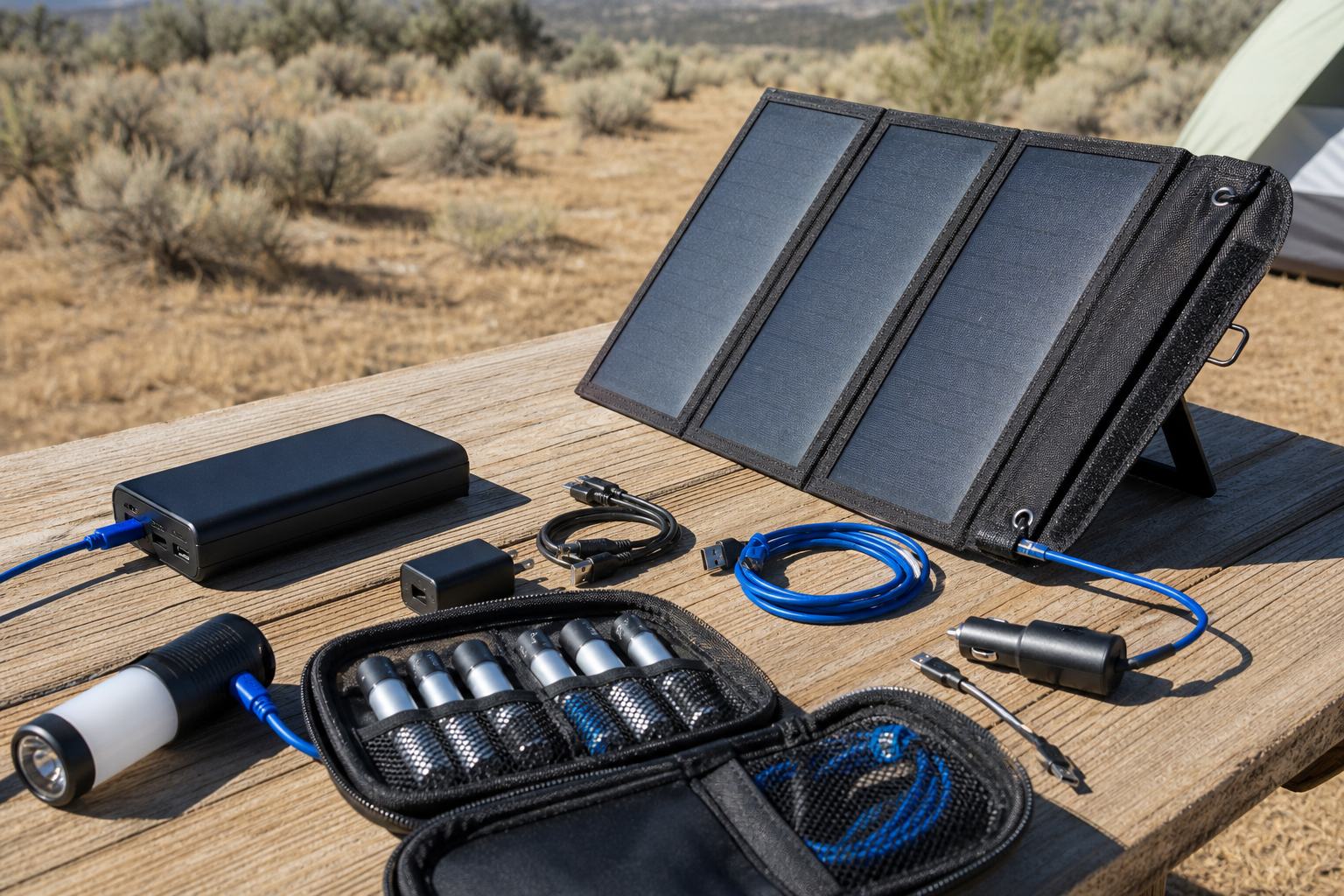
Camp charging kit with solar panel, power bank, cables, and spare batteries

Camping lights are only helpful if they still work when you need them. Before a trip, it is worth checking whether your lights use disposable batteries, rechargeable batteries, USB charging, or some mix of all three.

For short trips, spare batteries or a charged power bank may be enough. For longer trips, rechargeable lights, phones, cameras, and other small electronics can make power planning more important. Cold weather can also shorten battery life, so backups are not a bad idea.

Most beginners do not need to start with a large power station unless they already know they have a reason for one. A simple power bank, extra batteries, and the right charging cables can cover a lot of normal camping lighting needs.

Below are a few battery and charging options that can help keep lights and small devices working while camping.

1Anker Nano Power Bank 10,000mAh 30W with Built-In USB-C CableA compact weekend power bank for phones, rechargeable headlamps, and small electronics when you do not need a full power station. The built-in USB-C cable is convenient in a camp bag because one fewer loose cable has to be found in the dark, though campers with mixed devices may still want a backup cord.
Pros
  • Compact for the capacity
  • Built-in USB-C cable
  • Good weekend backup for small devices
Cons
  • Built-in cable may not fit every device
  • Not enough for group power
  • Still needs pre-trip charging
2Jackery Explorer 300 Portable Power StationThe Explorer 300 is for car campers who need more backup power than a pocket battery bank but do not need a huge power station. It can handle phones, cameras, laptops, lanterns, and small electronics around basecamp. It is too heavy for backpacking and should not be framed as appliance power, but it is a useful buffer for longer campground stays.
Pros
  • Useful for phones, cameras, laptops, and camp lights
  • Multiple port types
  • Good car-camping power buffer
Cons
  • Too heavy for backpacking
  • Not for high-draw appliances
  • More expensive than simple power banks
3Panasonic BQ-CC55SBA Advanced Eneloop ChargerThis charger is a practical add-on if your headlamps, lanterns, radios, or small electronics still use AA or AAA batteries. It helps turn battery-powered gear into a reusable system instead of a disposable habit. It will not replace a USB power bank, but it supports a cleaner backup-lighting setup when you still rely on standard cells.
Pros
  • Supports a reusable battery setup
  • Useful for AA/AAA lights
  • Reduces disposable battery waste over time
Cons
  • Only helps standard-cell devices
  • Requires pre-trip charging
  • Not a USB power bank