Camp Gear Advisor
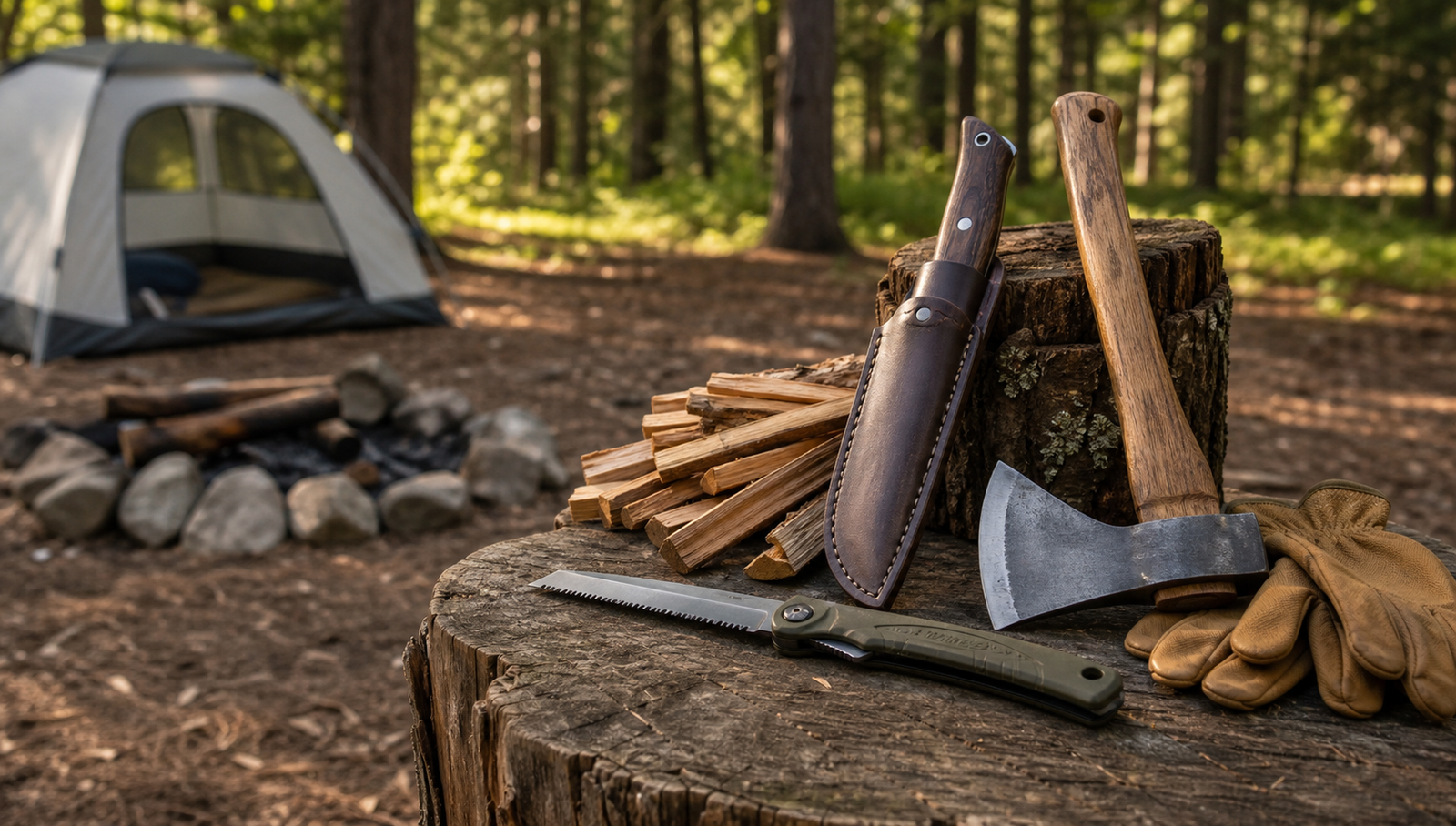
Camping knife, hatchet, and camp tools organized for a campsite
Back to gear hub

Knives and Axes

Camp knives, saws, and axes are useful, but they are also the kind of gear beginners can overbuy fast. Most new campers do not need every sharp tool at once. A modest knife or multitool usually covers the everyday stuff, while saws and hatchets make more sense once you know you will be camping somewhere fires are allowed and firewood prep is part of the trip. This page keeps the focus on what each tool is actually for, what is worth considering first, and what safety gear belongs with it.

As an Amazon Associate, Camp Gear Advisor may earn from qualifying purchases. Prices and availability can change, so check the product page for current details before buying.

Camp Knives

Small folding and fixed-blade knives for food prep, cord, packaging, and simple camp tasks.
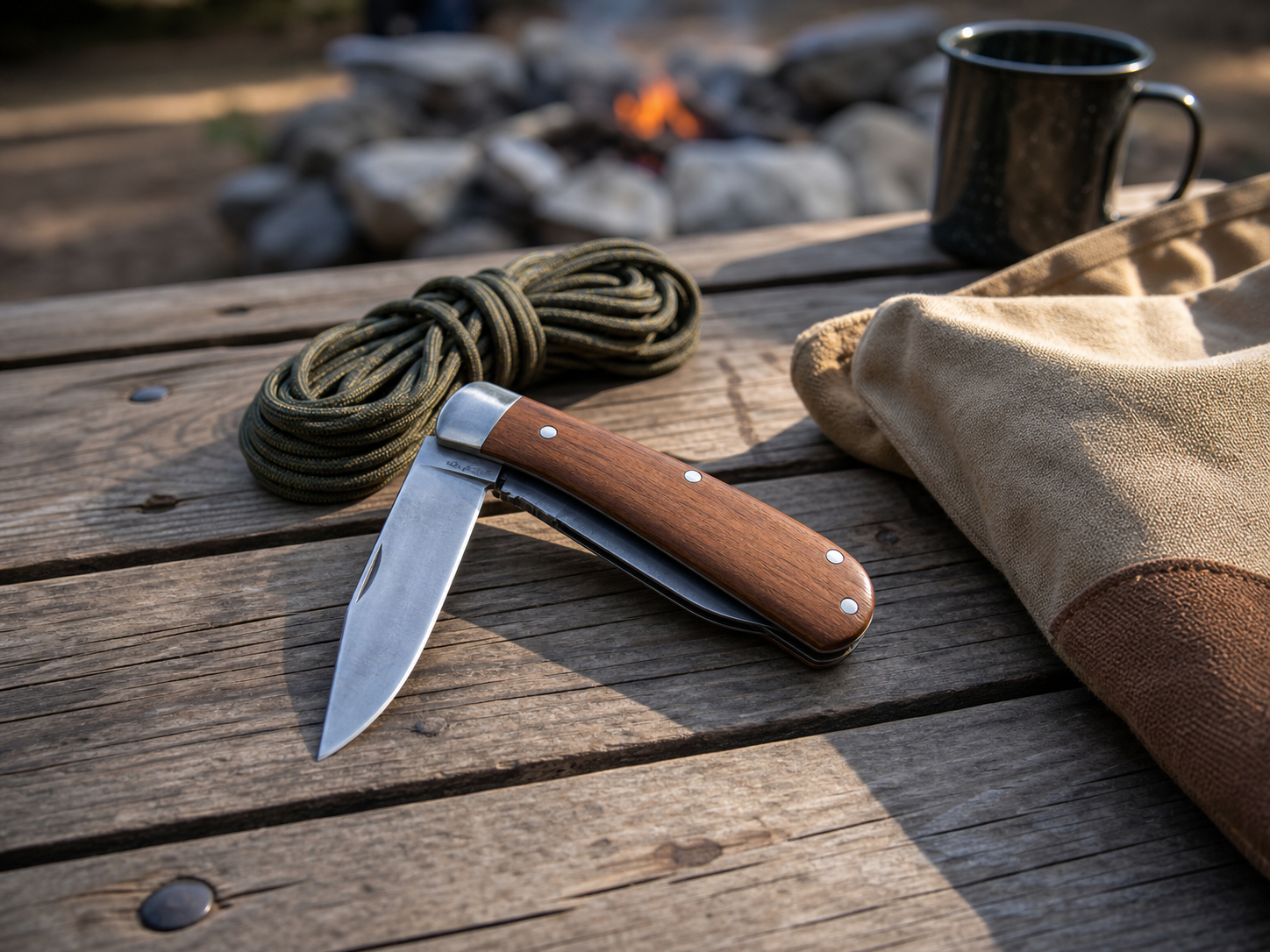
Wood-handled folding camp knife on a weathered campsite table with cord nearby

A camp knife should feel useful and controlled, not intimidating. Most camping knife jobs are ordinary things: slicing food, cutting cord, opening packaging, trimming tape, shaving a little tinder, or helping with a small gear repair.

For beginners, the sweet spot is usually a modest folding knife with a dependable lock or a small fixed blade with a secure sheath. Look for a handle that feels easy to grip and a blade size that matches real camp chores. For most first campers, a simple 2.5- to 4-inch blade is plenty.

The safety side is simple but important. A sharp knife takes less force than a dull one, but you still want to cut away from yourself, keep your other hand out of the blade path, and close or sheath the knife whenever you set it down.

Look for camp knives that prioritize control, safe storage, and everyday usefulness over oversized survival styling.

1CIVIVI Button Lock Elementum II Folding KnifeThe Elementum II is a good everyday camp folder for people who want a smooth pocket knife without oversized survival styling. It fits packaging, cord, light food prep, and small gear chores while staying compact enough to actually carry. The button lock is convenient, but it still needs careful handling and cleaning after dusty or sticky camp use.
Pros
  • Comfortable everyday size
  • Smooth button-lock action
  • Good value materials
Cons
  • Button lock still needs safe handling
  • Not for wood processing
  • Folding knives need cleaning
2Morakniv Companion Stainless Steel Fixed-Blade KnifeThe Companion is a practical fixed blade for campers who prefer a simple sheath knife over a folder. It is useful for food prep, rope, tape, and basic camp chores, and it is easier to rinse clean than many pocket knives. A fixed blade takes more intentional storage, but the value is hard to ignore.
Pros
  • Excellent value
  • Easy to clean stainless blade
  • Secure sheath for camp-bin storage
Cons
  • Basic sheath
  • Not full tang
  • Fixed blade may be more than some campers need
3CRKT Drifter Folding KnifeThe Drifter is a small budget folder for ordinary campsite cutting jobs. It makes sense as a controlled, low-cost knife for opening packaging, trimming cord, or keeping in a camp bin. It is not the most comfortable option for longer food prep or heavier work, but it covers basic needs without pushing beginners into expensive knives.
Pros
  • Affordable
  • Compact pocket size
  • Simple locking folder
Cons
  • Basic steel
  • Small handle
  • Not ideal for food prep
4Petzl Spatha Folding KnifeThe Spatha is better treated as a rope-and-gear knife than a general kitchen camp knife. The serrated edge, light build, and clip-friendly shape make it useful for cord, line, and repair work. Campers who mostly slice food may prefer something simpler, but it fits well in a repair-focused outdoor kit.
Pros
  • Great for cord and rope
  • Light and easy to clip
  • Useful for gear repairs
Cons
  • Specialized blade shape
  • Less ideal for food prep
  • Small handle

Multitools

Compact pliers, scissors, screwdrivers, and small blades for campsite fixes.

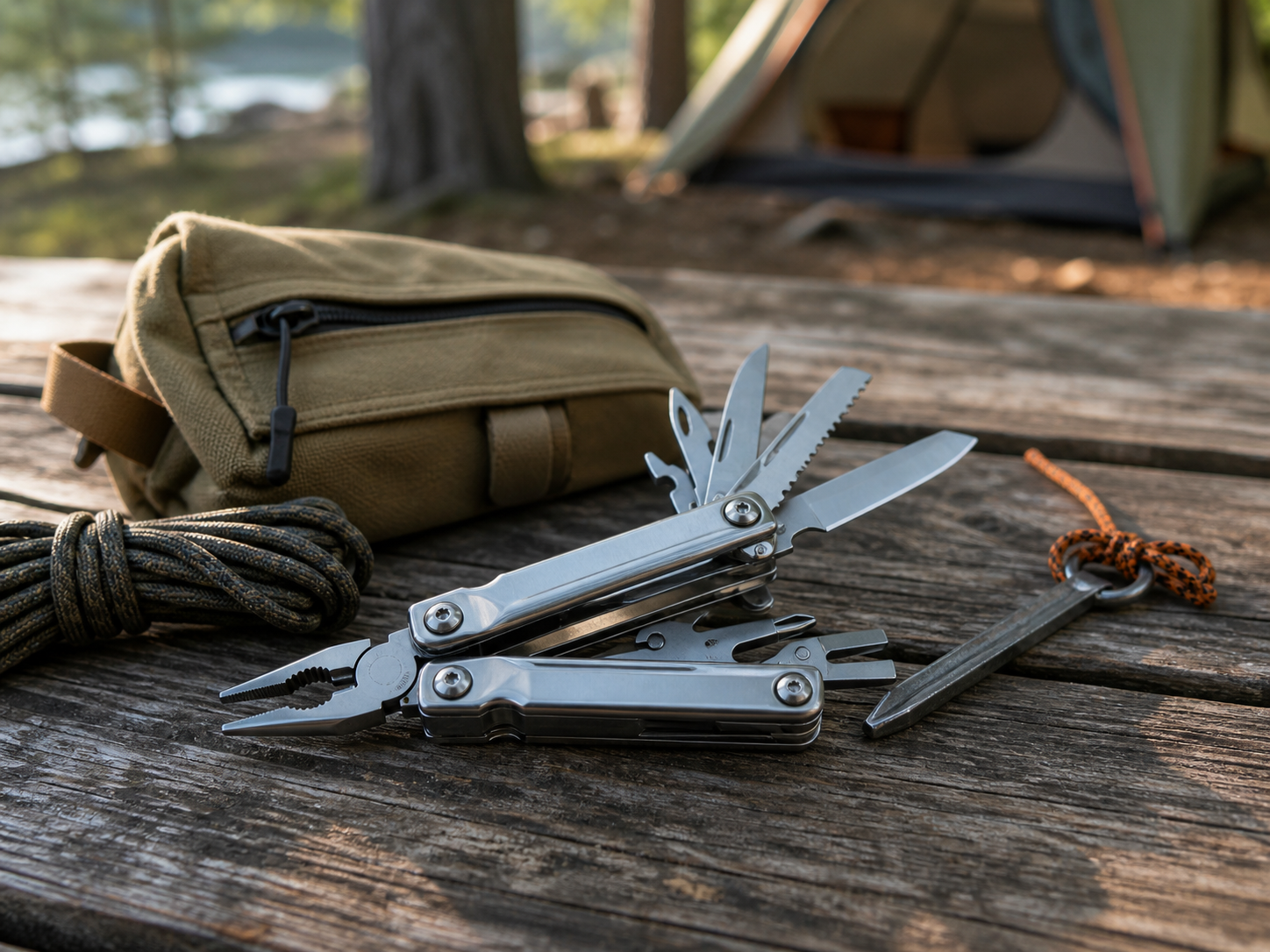
Open multitool on a weathered campsite table with cord and a small gear pouch nearby

A multitool is often the most useful first sharp tool for a new camper because it handles more than cutting. Pliers, scissors, screwdrivers, can openers, tweezers, and a small blade can solve a lot of little campsite problems without taking up much space.

This is the tool you reach for when a stove screw loosens, a zipper pull breaks, packaging will not open, cord needs trimming, or something needs a quick adjustment. It will not replace a real saw or hatchet, but it is more useful than people expect for repairs and small camp tasks.

Avoid novelty multitools that try to include everything but do nothing well. A reliable mid-size model with comfortable handles and locking tools is usually a better buy than a bulky gadget that stays buried in the gear bin.

These multitool slots focus on practical camp repairs, food packaging, small fixes, and backup tasks.

1Leatherman Wave Plus MultitoolThe strongest all-around multitool pick here. It gives campers pliers, scissors, drivers, blades, and a saw in one tool, which makes it useful for stuck zippers, loose screws, packaging, and quick repairs. It is heavy and pricey for minimalist kits, but for car camping it earns the space.
Pros
  • Very versatile camp repair tool
  • Includes scissors and drivers
  • Good all-around multitool
Cons
  • Heavy for backpacking
  • Premium price
  • More tool than minimalist campers need
2Leatherman Skeletool CX MultitoolA better fit for campers who want pliers and a good blade without carrying a full tool brick. It is lighter, easier to pocket, and focused on common jobs. The downside is that it skips useful tools like scissors, so it is more of a compact helper than a full repair kit.
Pros
  • Light for a plier multitool
  • Focused useful tool set
  • Easy to carry
Cons
  • No scissors
  • Limited repair tools
  • Not as capable as full-size multitools
3Leatherman Signal MultitoolCamping-focused and useful, but not subtle. The pliers, saw, and outdoor extras make sense for campers building a more prepared kit, especially for car camping or day trips. Some features may be overkill if all you need is packaging, cord, and stove adjustments.
Pros
  • Camping-focused feature set
  • Includes saw and emergency extras
  • Good for campsite repair tasks
Cons
  • No scissors
  • Survival extras may be overkill
  • Costs more than simpler tools
4Leatherman Rebar MultitoolA sturdy classic-style multitool for people who care more about strong pliers and durable tools than fast one-hand access. It works well as a camp-bin repair tool, especially for harder use. The inside-opening layout is less convenient than newer designs, so it is better for deliberate repairs than quick pocket use.
Pros
  • Strong pliers
  • Durable classic design
  • Good value in the Leatherman lineup
Cons
  • Inside-opening tools
  • Heavier than minimalist tools
  • Less convenient than outside-access tools

Folding Saws

Compact saws for permitted firewood prep, small branches, and controlled cutting jobs.

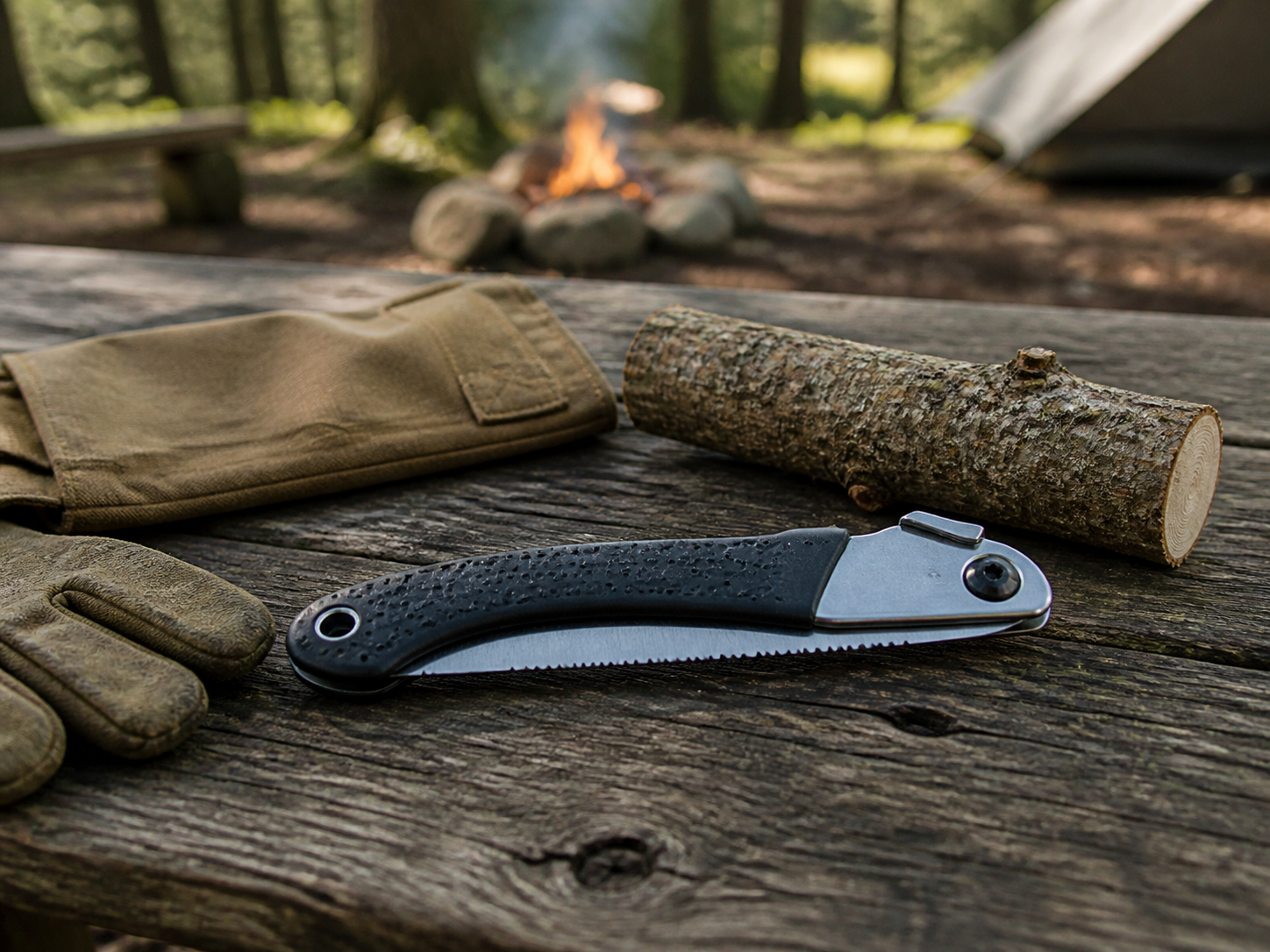
Closed folding camp saw on a weathered campsite table with gloves and a small log nearby

For many beginners, a folding saw makes more sense than a hatchet. It cuts without swinging force, packs safely when folded, and is easier to control when you are dealing with small wood where collection is allowed.

A compact 5- to 7-inch saw is enough for light camp chores and small branches. A 9- to 12-inch folding saw is better for car camping firewood prep. Bow saws cut quickly, but they take more space and usually make more sense for basecamp than a small weekend kit.

The rule piece matters here: check whether fires and firewood collection are allowed before buying tools for wood prep. When in doubt, buy local firewood near the campground and keep cutting to a minimum.

Folding saws are often the friendliest first firewood tool because they are compact, controlled, and useful beyond camping.

1Bahco 396-LAP Laplander Folding SawThe Laplander is a friendly first folding saw for permitted small-wood jobs. It is compact, controlled, and easier for many campers than swinging a hatchet. It will not process big firewood quickly, but for small branches, kindling prep, and responsible campground use, it is a sensible starter saw.
Pros
  • Affordable and proven
  • Locks open and closed
  • Good compact camp size
Cons
  • Shorter blade is slower on larger wood
  • Not for heavy firewood processing
  • Needs safe blade handling
2Silky PocketBoy 170 Folding SawThe PocketBoy is a compact, high-quality pull saw for campers who want efficient cutting in a very packable size. It rewards careful technique and cuts better than its size suggests. The teeth are aggressive and sharp, so it needs respect, slow starts, and safe storage after use.
Pros
  • Efficient pull-cut blade
  • Compact and high quality
  • Good for small wood
Cons
  • Thin blade requires technique
  • Very sharp teeth need caution
  • Less reach than larger saws
3Silky Professional BigBoy 360 Folding SawThe BigBoy is for car campers who actually need to process permitted wood and want a faster tool than a pocket saw. It is larger, sharper, and more capable, while avoiding the swing risk of an axe. It is too much saw for casual kits, but useful where legal firewood prep is part of the trip.
Pros
  • Fast cutting on larger wood
  • Folds for transport
  • Good alternative to swinging tools
Cons
  • Large for casual kits
  • Aggressive sharp blade
  • Overkill where firewood processing is not allowed

Hatchets and Axes

Conditional tools for car campers splitting allowed or purchased firewood at camp.

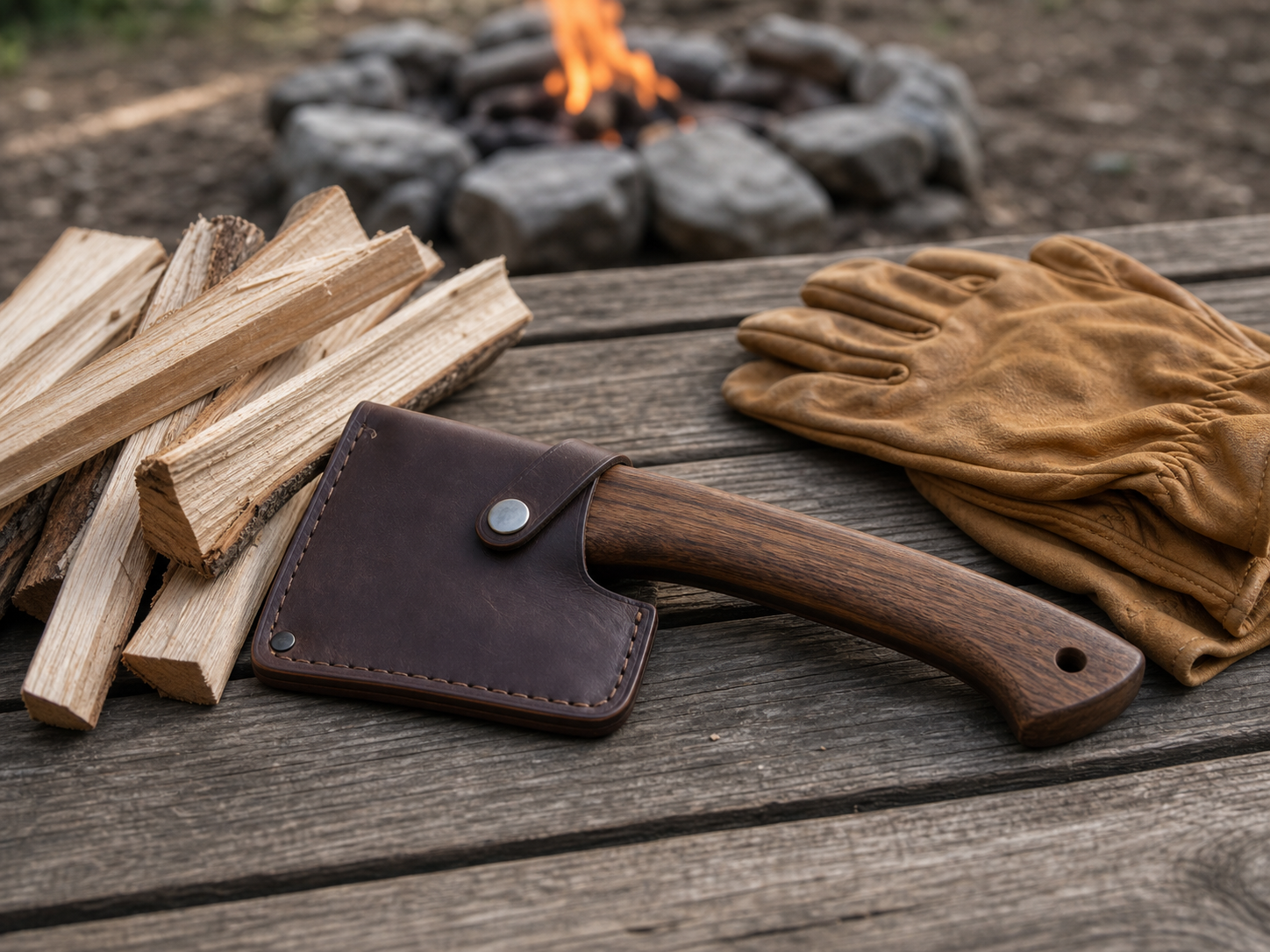
Sheathed camp hatchet on a weathered campsite table with split kindling and gloves nearby

A hatchet or camp axe is not a must-have for every camper. It makes the most sense for car camping where fires are permitted and you are splitting purchased local firewood into smaller pieces. It is usually not the right tool for backpackers, casual weekend campers who do not build fires, or anyone camping where fire restrictions are common.

The useful job here is usually splitting, not chopping. Splitting means opening already-cut firewood along the grain. Chopping trees or standing dead wood is a different thing, and in many places it is not allowed or not responsible.

For a first hatchet, look for a secure head, a covered edge, and a handle you can grip with confidence. A short hatchet packs easier but is less forgiving. A slightly longer camp axe gives more leverage for splitting but takes more room and needs a safer swing area. If that sounds like more than you want to deal with, a folding saw and pre-split firewood is the cleaner choice.

These hatchet and axe slots are for car campers who are legally and responsibly processing purchased or permitted firewood at camp.

1Fiskars X7 Hatchet 14-InchThe X7 is a practical starter hatchet for splitting small kindling around established fire rings when fires and wood prep are allowed. It is compact enough for a car-camp bin and easier to maintain than many wood-handled axes. The important caveat is use case: it needs safe swing space and is not required camping gear.
Pros
  • Good value
  • Durable handle
  • Compact enough for a car-camp bin
Cons
  • Limited splitting power
  • Requires safe swing space
  • Not needed for every camper
2Estwing Sportsman's Axe 14-InchThe Estwing is a durable one-piece axe for car campers who like a more traditional compact tool. It can handle kindling and light camp chores, but the steel handle transfers more shock than composite or wood. It belongs with gloves, a sheath, and careful firewood habits, not loose in a beginner gear bin.
Pros
  • Very durable one-piece build
  • Compact size
  • Includes sheath
Cons
  • More shock than composite handles
  • Heavier feel
  • Needs careful edge safety
3Kindling Cracker Firewood Kindling SplitterThe Kindling Cracker is a car-camping-only splitter for people who want a more controlled way to make kindling from purchased firewood. It is heavy and not versatile, but it reduces the need to swing a hatchet. Best fit is a repeat campground setup where there is room in the vehicle and fires are actually allowed.
Pros
  • Controlled splitting setup
  • Safer than swinging for some users
  • Good for purchased firewood kindling
Cons
  • Heavy and bulky
  • Requires a mallet
  • Car camping only

Sharpening and Safety Gear

Support gear for safer carrying, cleaner cuts, tool maintenance, and minor injury prep.

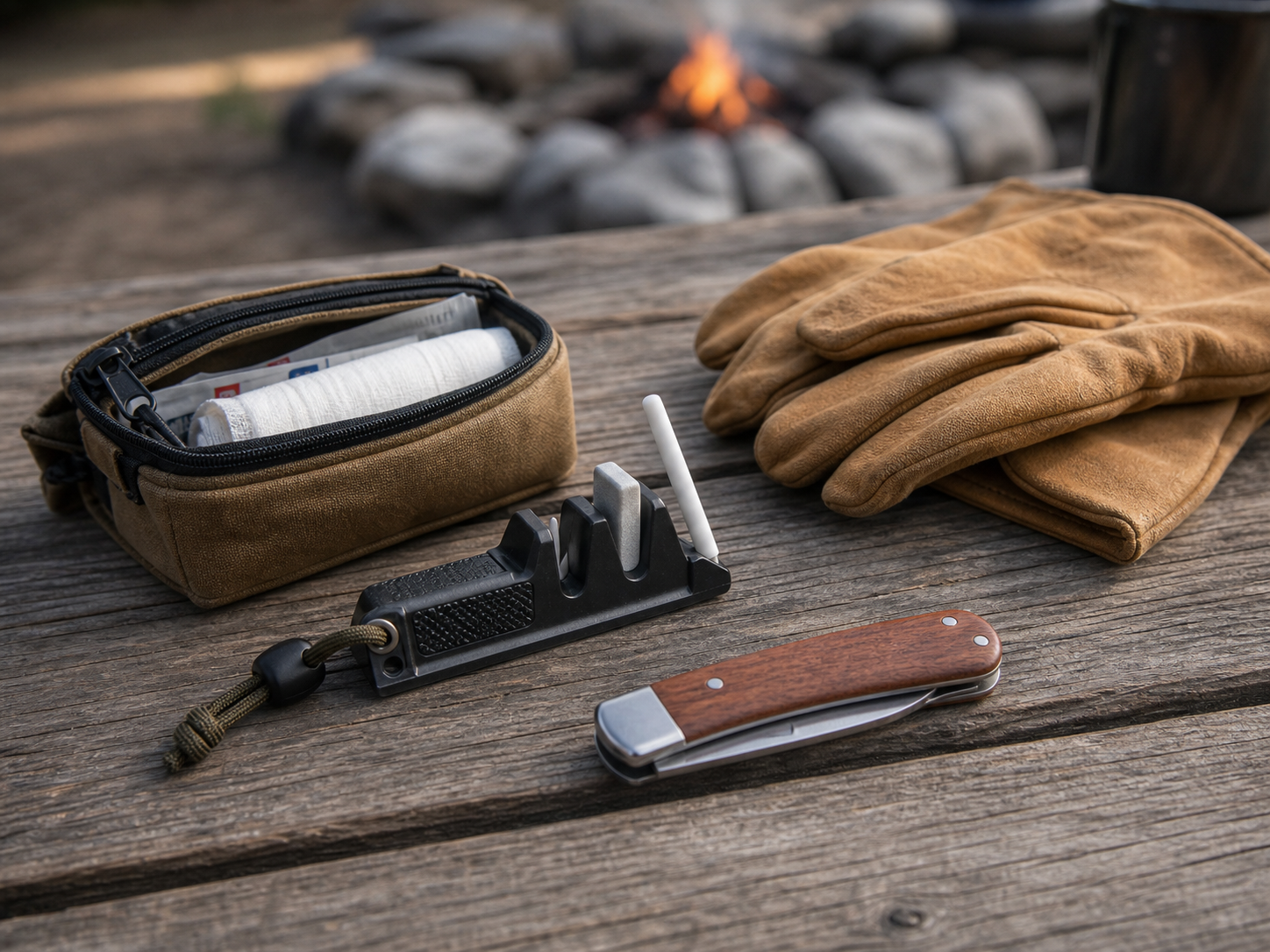
Camp knife, sharpener, first aid pouch, and gloves arranged on a weathered campsite table

Sharp tools are safer and more useful, but sharpening gear should be simple for beginners. A compact pull-through sharpener or guided field sharpener is easier to learn than a full stone system. The goal is not to become a knife maker at camp; it is to maintain a clean working edge so you are not forcing a dull blade through rope, food, or wood.

Safety accessories are not extras. A blade cover or sheath protects hands in a gear bin. Gloves help with firewood and tool handling, though they should not make your grip clumsy. Eye protection is smart when splitting wood or sawing dry branches.

A small first-aid kit should be easy to reach and stocked for cuts, scrapes, and bleeding control. Before each trip, inspect your tools for loose axe heads, cracked handles, damaged saw blades, loose knife locks, rust, and dull edges. It is not exciting gear, but it is the part that makes the rest of the kit make sense.

These support items make camping knives, saws, and hatchets safer to carry, easier to maintain, and less stressful for beginners.

1Work Sharp Guided Field SharpenerThe Guided Field Sharpener is a good maintenance piece for campers carrying knives or axes regularly. It helps keep edges usable without bringing a full sharpening setup, and the guided format is less intimidating than loose stones. It still takes patience, because rushed sharpening can make an edge worse instead of better.
Pros
  • Guided angles help beginners
  • Multiple sharpening surfaces
  • Small enough for a camp kit
Cons
  • Takes practice
  • Not a full workshop system
  • Can remove too much material if rushed
2Sharpal 101N 6-In-1 Pocket Knife SharpenerThe Sharpal 101N is a tiny backup sharpener for quick touch-ups rather than serious edge work. It fits a camp pouch and can help when a knife gets dull mid-trip. It is not as precise as a guided system, but it is cheap, small, and easy for beginners to understand.
Pros
  • Cheap and compact
  • Simple pull-through use
  • Includes emergency extras
Cons
  • Less precise than guided stones
  • Best for touch-ups, not full sharpening
  • Pull-through sharpeners are not ideal for every blade
3Adventure Medical Kits Mountain Series Hiker Medical KitThis Hiker kit is a compact first-aid base for normal camping cuts, scrapes, and trail problems. It should be treated as a starting point, not a finished medical plan. Add personal medications, check the contents before trips, and keep it reachable instead of buried under the same tools it is meant to support.
Pros
  • Outdoor-focused contents
  • Good small-camp first aid base
  • Easy to customize
Cons
  • Not a trauma kit
  • Needs personal medications added
  • Must be checked and restocked